
Choosing an instrument for your child can feel like a big decision. Should they start with piano, vocal lessons, or violin?
There is no single “best” instrument for every child. The right choice depends on your child’s age, personality, interests, learning style and musical goals.
In this guide, we’ll compare piano, vocal and violin lessons to help Singapore parents decide which instrument may be the best fit for their child.
Piano: A Strong Foundation for Young Musicians
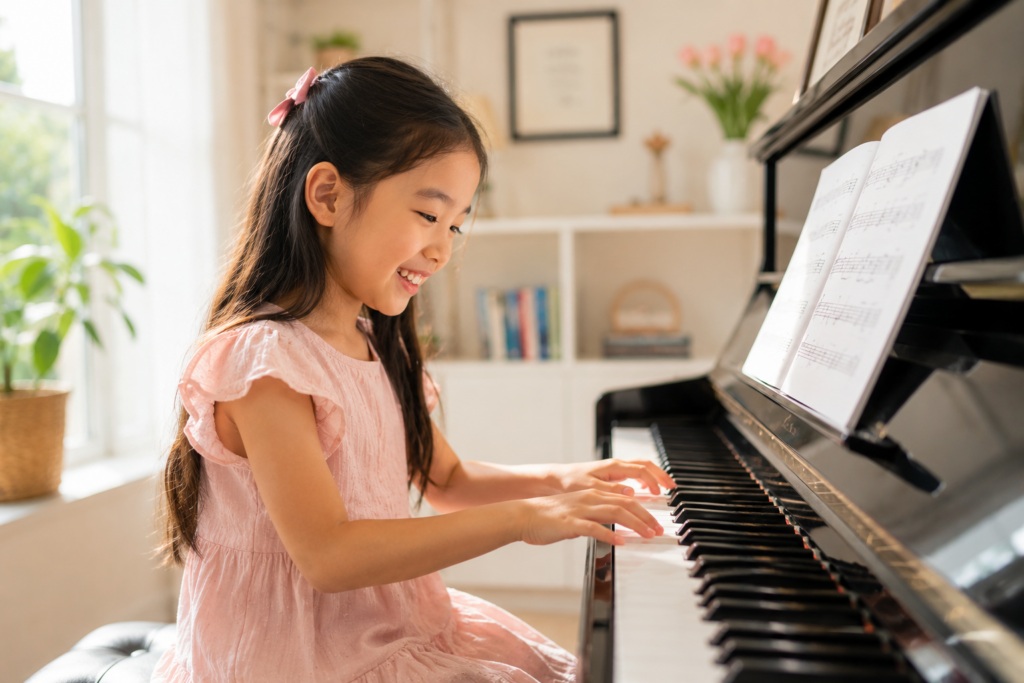
Piano is one of the most popular instruments for children, and for good reason. It provides a strong foundation in music reading, rhythm, melody, harmony and music theory.
Why choose piano?
- Builds a strong musical foundation – Children can see notes, intervals, chords and patterns clearly on the keyboard.
- Develops coordination – Playing with both hands helps children develop hand-eye coordination and fine motor skills.
- Supports music theory learning – Concepts such as rhythm, scales, chords and notation can be introduced naturally through playing.
- Encourages creativity – Children can experiment with melodies, chords and simple compositions.
- Suitable for different learning styles – Piano can work well for children who enjoy structured learning and seeing how things fit together.
Piano may be a good choice if your child enjoys: structured activities, playing melodies, learning through visual patterns or exploring different types of music.
Vocal: Build Musicality and Confidence Through Singing
Every child already has a voice, which makes singing a natural introduction to music.
Vocal lessons can help children develop their sense of pitch, rhythm, breathing and musical expression while also building confidence.
Why choose vocal lessons?
- Develops pitch awareness – Children learn to recognise and reproduce different notes.
- Improves musical expression – Singing helps children explore dynamics, phrasing and emotion.
- Builds confidence – Performing a song can be a great way for children to become more comfortable expressing themselves.
- Develops listening skills – Children need to listen carefully to pitch, rhythm and musical accompaniment.
- Encourages self-expression – Singing allows children to connect personally with the music they perform.
Vocal lessons may be a good choice if your child: loves singing, enjoys performing, expresses themselves through music or is naturally drawn to songs.
Violin: Develop Listening, Coordination and Patience
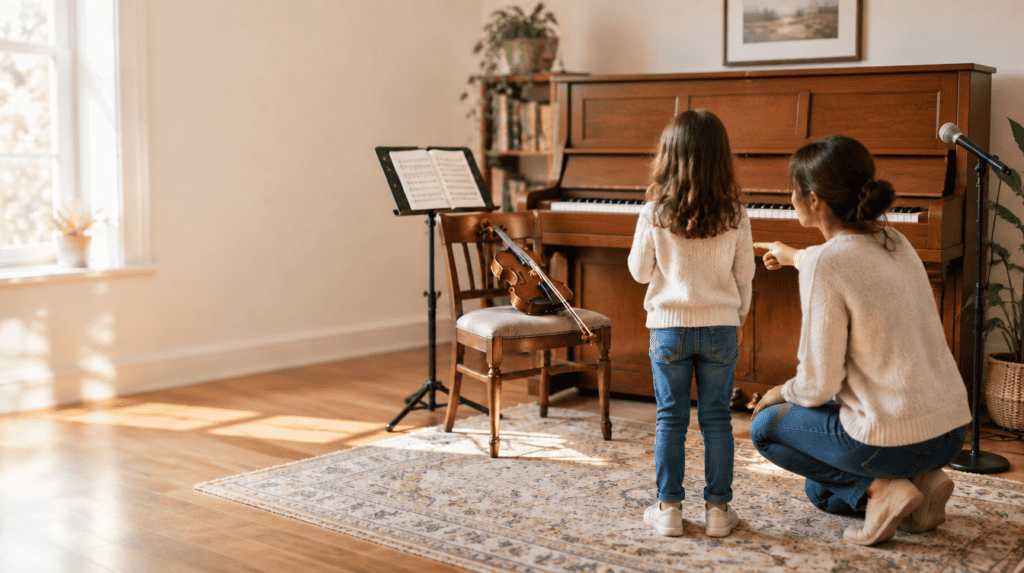
The violin is a beautiful and expressive instrument, but it can take time for beginners to develop good technique. Unlike piano, there are no keys that tell you exactly where to place your fingers.
This means children gradually develop their ear, finger placement and coordination together.
Why choose violin?
- Develops a strong musical ear – Children learn to listen carefully for accurate pitch.
- Improves coordination – Bowing and fingering require both hands to work together.
- Develops posture and body awareness – Good playing technique requires attention to positioning and movement.
- Builds patience – Producing a beautiful sound on the violin takes consistent practice.
- Encourages musical expression – Children can explore tone, dynamics and phrasing as their technique develops.
Violin may be a good choice if your child: enjoys challenges, has patience, loves instrumental music or is interested in expressive playing.
Piano vs Vocal vs Violin: Quick Comparison
Piano | Vocal | Violin | |
Music reading | ⭐⭐⭐⭐⭐ | ⭐⭐⭐ | ⭐⭐⭐⭐ |
Pitch training | ⭐⭐⭐ | ⭐⭐⭐⭐⭐ | ⭐⭐⭐⭐⭐ |
Coordination | ⭐⭐⭐⭐⭐ | ⭐⭐⭐ | ⭐⭐⭐⭐⭐ |
Confidence & performance | ⭐⭐⭐⭐ | ⭐⭐⭐⭐⭐ | ⭐⭐⭐⭐ |
Music theory foundation | ⭐⭐⭐⭐⭐ | ⭐⭐⭐ | ⭐⭐⭐⭐ |
Beginner-friendly | ⭐⭐⭐⭐⭐ | ⭐⭐⭐⭐⭐ | ⭐⭐⭐ |
Creativity & expression | ⭐⭐⭐⭐⭐ | ⭐⭐⭐⭐⭐ | ⭐⭐⭐⭐⭐ |
The ratings above are only a general guide. A child’s individual learning experience depends greatly on their teacher, lesson structure and level of interest.
So, Which Instrument Should Your Child Learn First?
Rather than choosing an instrument based only on which one is considered “easier”, start with your child.
Ask yourself:
What does my child naturally enjoy?
If they are always singing, vocal lessons could be a natural starting point. If they are fascinated by keyboards and melodies, piano may be a better fit. If they are drawn to orchestral or string instruments, violin could be worth exploring.
What type of learner are they?
Some children enjoy structured, visual learning, while others learn better through listening and movement.
What are your goals?
If you want to build a strong foundation in music theory and notation, piano is often a practical starting point. If confidence and performance are priorities, vocal lessons may be particularly suitable.
Does Age Matter?
Age can influence which instrument is most suitable, but there is no single perfect age for every child.
Younger children may benefit from an approach that focuses on exploration, movement and enjoyment before progressing into more structured instrumental learning.
As children grow, they can gradually develop the concentration, coordination and practice habits needed for more advanced instrumental study.
Most importantly, lessons should be age-appropriate and enjoyable. A positive first experience can make a big difference to a child’s long-term relationship with music.
What If My Child Doesn’t Know Which Instrument They Want?
That’s completely normal.
Children may need to try an instrument before they know whether they enjoy it. You can introduce them to different instruments through performances, listening activities or trial lessons.
It is also worth remembering that choosing one instrument does not mean your child can never learn another. Many children eventually explore a second instrument as their interests develop.
The Teacher Matters Too
The instrument is only one part of the learning experience. A supportive and encouraging teacher can make a significant difference in how a child feels about music lessons.
For children, especially beginners, lessons should be adapted to their age, personality and learning pace rather than following a one-size-fits-all approach.
At Kadenz Music Academy, our teachers provide personalised home-based piano, vocal and violin lessons across Singapore, allowing children to learn in a familiar environment while receiving individual attention.
Final Thoughts
Piano, vocal and violin can all provide valuable musical experiences for children. Instead of looking for the “perfect” instrument, focus on finding one that your child is interested in and a teacher who can make learning enjoyable.
The best first instrument is often the one that makes your child excited to learn, practise and come back for their next lesson.
Looking for music lessons in Singapore? Kadenz Music Academy offers personalised home-based piano, vocal and violin lessons for children and beginners. Get in touch with us to find an approach that suits your child.
Interested in our piano lessons for children in Singapore or violin lessons? You may also explore our trial music lessons to experience our teaching approach firsthand.
Frequently Asked Questions
Piano is a popular starting instrument because it provides a strong foundation in music reading, rhythm and theory. However, the best instrument depends on the individual child.
Violin can be more technically challenging at the beginning because children need to develop accurate finger placement and pitch without keys. With the right teacher and consistent practice, children can gradually build these skills.
Not necessarily. Children can start violin directly if they are interested and ready for the instrument. Piano can provide useful musical foundations, but it is not a requirement.
There is no universally easiest instrument. Children tend to progress more comfortably when they are genuinely interested in the instrument and enjoy their lessons.